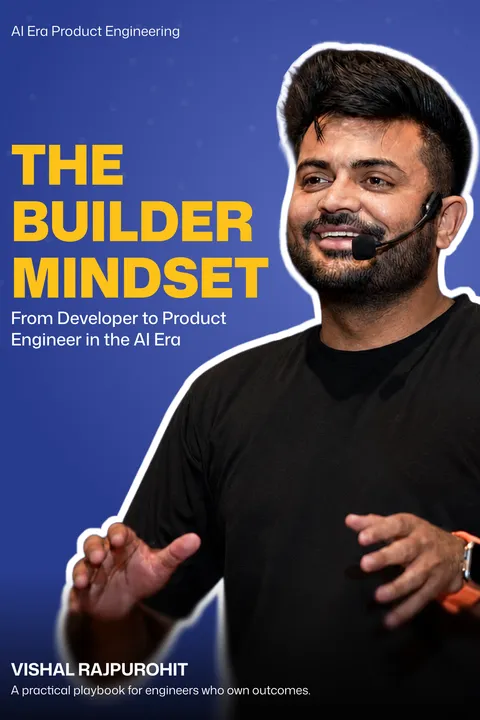
The Builder Mindset
From Developer to Product Engineer in the AI Era
As AI makes writing code cheap, the scarce skill becomes owning the outcome behind it: reading the user and the business, taking a real product bet, and exercising the judgement a ticket never asked for.
AI has made software creation faster, which raises the standard for what a valuable engineer must be rather than lowering it. This book is a practical operating model for that shift: understanding users and business impact, taking product bets deliberately, using AI as a co-builder instead of a shortcut, treating architecture and reliability as strategy, and building the communication and influence that get an engineer trusted with ownership. It ends with a field manual of team rituals and templates for putting the frameworks to work.
What it makes operable
- 01
Read a problem like a builder, not a ticket, using product-sense tools like the Bet Canvas and the 5P Builder Lens
- 02
Use AI as a co-builder without losing judgement, verifying its output against the product goal, constraints, and production reality
- 03
Turn architecture, shipping, and reliability into decisions the business can act on, not private engineering choices
- 04
Build influence without authority and run a 90-day plan for earning bigger ownership
Contents
31 of 31 published
Every chapter is free to read in the browser, cites its own sources, and stands on its own if you came for one decision rather than the whole argument.
- 01Builders, Not Ticket TakersThe difference between waiting for tickets and owning the outcome behind them.7 min
- 02The End of the "Just Code" CareerWhy faster code without judgement can make a product worse, not better.5 min
- 03Start With the User, Not the BacklogReading a backlog item back to the actual person it is supposed to help.6 min
- 04Problems, Bets, and Product SenseTreating a feature as a bet with a cost, a payoff, and a way to be wrong.5 min
- 05Business Impact for EngineersConnecting a technical decision to revenue, risk, and the metrics leadership actually watches.5 min
- 06AI as a Co-Builder, Not a ShortcutUsing AI to create options, then verifying them against the product goal and production reality.4 min
- 07Engineering Taste and Technical JudgementThe trade-off instincts that separate a working answer from the right one.5 min
- 08Architecture Is Business StrategyWhy a technical decision is a bet on the company's future options, not a private engineering choice.4 min
- 09Shipping Small Without Creating ChaosFinding the smallest safe release that still lets you learn something real.4 min
- 10Reliability Is a Product FeatureTreating uptime and failure behaviour as something users buy, not an ops afterthought.4 min
- 11Metrics That MatterChoosing the few numbers that actually change a decision, and ignoring the rest.3 min
- 12Platforms, Paved Roads, and Developer LeverageBuilding the road so the next feature ships faster than this one did.4 min
- 13Communication Is Part of the ArchitectureWhy how a decision is explained is part of whether it survives contact with the team.3 min
- 14Influence Without AuthorityEarning the room to shape a decision you were never given formal control over.3 min
- 15The 90-Day Builder TransformationA staged plan for turning ticket-taking into ownership over one quarter.5 min
- 16How to Use This Book With a TeamTurning the book's frameworks into four working sessions and three agreements a team actually runs.4 min
- 17The Monday Builder Operating CadenceA five-question weekly rhythm, closed by a Friday learning check, that connects product, engineering, AI, and delivery.3 min
- 18Feature Request TriageA four-step triage (capture, find the pain, classify, choose the next action) for turning requests into evidence instead of commands.3 min
- 19The AI-Assisted Delivery ProtocolFive stages (define the job, provide context, generate alternatives, verify, evaluate) that scale discipline to risk instead of slowing everything down.3 min
- 20Architecture and Technical Debt TriageNaming a debt's type, estimating its impact, and funding speed and safety instead of arguing for cleanliness in general.3 min
- 21Reliability and Metrics ReviewA recurring review that keeps reliability and metrics honest instead of aspirational.3 min
- 22Founder-Engineer Working AgreementNaming, in writing, what a founder and an engineer each owe each other.3 min
- 23The Builder Anti-PatternsThe habits that look like ownership but quietly recreate the ticket-taker role.4 min
- 24The Builder Scorecard for Hiring and GrowthA concrete way to hire for and grow ownership instead of guessing at it.3 min
- 25The Future Belongs to BuildersWhat changes, and what still matters, once code itself stops being the scarce thing.3 min
- 26Builder Self-AssessmentA ten-area scorecard for locating yourself between implementer and force multiplier, and picking one behavior to change this week.2 min
- 27The Bet Canvas TemplateA one-page canvas for writing down a feature bet's user, pain, hypothesis, riskiest assumption, and kill criteria before you build it.1 min
- 28AI Context Pack TemplateA six-part context pack to hand an AI co-builder before asking it to generate substantial code, tests, plans, or documentation.1 min
- 29Architecture Decision Record TemplateA short-form ADR that records context, decision, options considered, trade-offs, and a review date so a future engineer understands why.1 min
- 30Founder-Engineer Alignment ChecklistA seven-section checklist for aligning outcome, user, scope, business, technical trade-offs, delivery, and learning before major work starts.2 min
- 3190-Day Builder Plan WorksheetA three-stage 90-day worksheet, observe, build, and scale, for turning the builder mindset into one visible proof point.1 min
In the age of AI
The advantage was never the model. It's knowing what to build with it — and having a team that can actually ship it.
That's the part I help with: finding where AI genuinely makes your business faster, deciding what's worth building, and standing behind it once it's live.
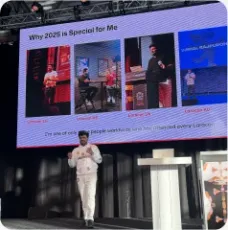
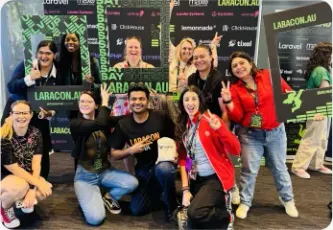
Four offices, one very full passport
Every dot on this map is a conversation I still remember.

- Where I've spoken
- Office