Agents That Finish
Engineering long-horizon reliability into software that runs without you
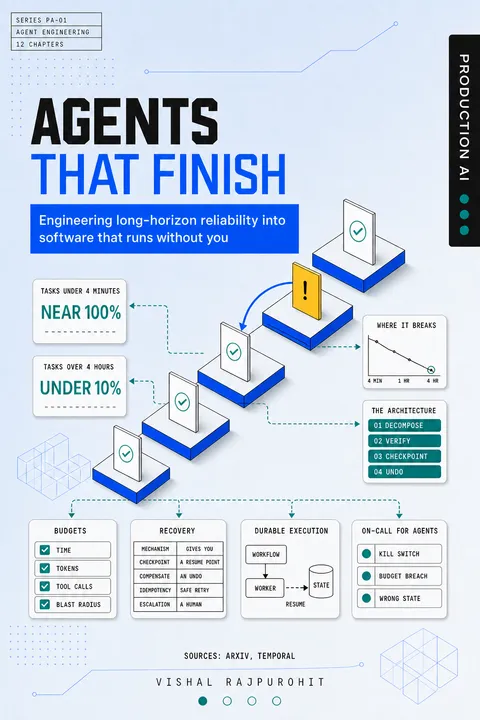
Agent reliability is an architecture, not a model property: systems complete multi-hour work because they can decompose it, verify each step, checkpoint state and undo a wrong commitment.
Frontier models are close to perfect on work a skilled person would finish in four minutes and close to useless on work that takes four hours. The gap is not intelligence. It is that most agent architectures cannot notice a wrong intermediate state, let alone roll one back, so the first bad commitment is inherited by every step after it. This book builds outwards from that failure mode: decomposition as a real artifact, verification between steps, checkpoints an agent can resume from, compensating actions for effects that already left the system, and budgets that bound the damage when none of it works.
What it makes operable
- 01
Instrument the step where your agent's first wrong commitment happens
- 02
Design checkpoints and compensating actions an agent can genuinely recover through
- 03
Place verification gates between steps instead of trusting the final answer
- 04
Measure a reliability horizon for your own workload rather than a benchmark's
Contents
12 of 12 published
Every chapter is free to read in the browser, cites its own sources, and stands on its own if you came for one decision rather than the whole argument.
- 01The Four-Minute Agent and the Four-Hour TaskWhere the reliability horizon actually sits, and why capability scores hide it.11 min
- 02Why Failures Compound: The No-Recovery BottleneckOne wrong intermediate state, inherited by every step that follows it.11 min
- 03Decomposition as an Engineering Artifact, Not a PromptWriting the plan as a structure the runtime can check, resume and revise.10 min
- 04Checkpoints: What an Agent Must Be Able to Resume FromChoosing the state boundary that makes a restart cheap and a rollback possible.11 min
- 05Verification Gates Between StepsCheap per-step checks that catch a wrong commitment before it propagates.10 min
- 06Compensating Actions and Safe UndoReversing effects that already left your system, and admitting when you cannot.11 min
- 07Durable Execution: Workflows, Retries, IdempotencyWhere agent state lives when the process running it dies mid-task.11 min
- 08Tools Are the Real InterfaceDesigning an API for a caller that will sometimes get the arguments wrong.11 min
- 09Budgets: Time, Tokens, Tool Calls, Blast RadiusFour ceilings that turn an open-ended loop into a bounded operation.11 min
- 10Handing Control Back to a HumanEscalation as a designed path, carrying enough context to be actionable.11 min
- 11Measuring a Reliability Horizon for Your Own WorkloadBuilding the curve for your tasks instead of inheriting someone else's benchmark.11 min
- 12On-Call for AgentsAlerts, kill switches and the runbook for software that acts on its own.11 min
Evidence · 3 sources
Third-party sources behind the book's premise. Every figure in them belongs to the party that published it and is attributed to them in the text.
In the age of AI
The advantage was never the model. It's knowing what to build with it — and having a team that can actually ship it.
That's the part I help with: finding where AI genuinely makes your business faster, deciding what's worth building, and standing behind it once it's live.
Four offices, one very full passport
Every dot on this map is a conversation I still remember.

- Where I've spoken
- Office