The Software Engineer's Career Handbook
Deciding what to be good at while the machines get better
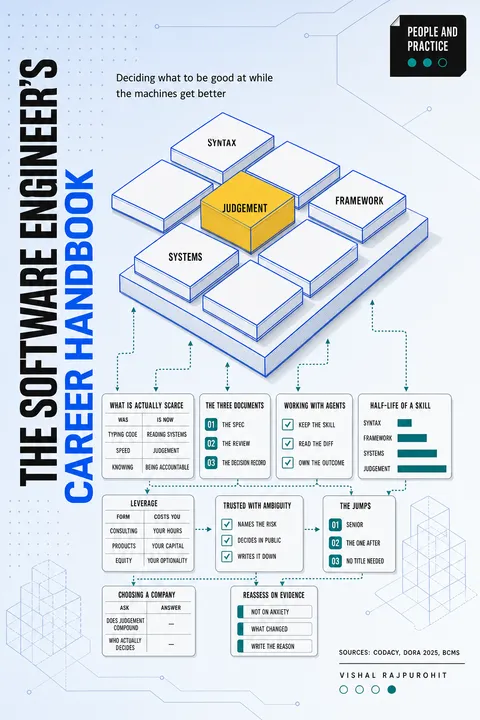
The scarce thing is no longer producing code; it is being accountable for judgement: reading systems, specifying intent, and being trusted with ambiguity.
Career advice written against the old ladder tells you to get faster at producing code, which is the part that stopped being scarce. This book is written against the shift instead: what is actually rare now, how to build comprehension and specification as deliberate skills, how to work with agents without losing the ability you would need without them, and how to choose problems, companies and forms of leverage that make judgement compound rather than depreciate.
What it makes operable
- 01
Choose skills against what is actually scarce, not against last decade's ladder
- 02
Work with agents without deskilling yourself
- 03
Use writing, meaning specs, reviews and decision records, as the leverage it has become
- 04
Pick problems, companies and forms of leverage deliberately
Contents
13 of 13 published
Every chapter is free to read in the browser, cites its own sources, and stands on its own if you came for one decision rather than the whole argument.
- 01What Is Actually Scarce NowJudgement, accountability, and reading a system you did not build.11 min
- 02Reading the Evidence About Your Own JobTracing a career-defining number back to its source, or refusing to act on it.13 min
- 03Depth, Breadth, and the Half-Life of a SkillDeciding what to learn deeply when the surface keeps moving under you.12 min
- 04Reading Systems Faster Than You Write ThemComprehension as deliberate practice, now the higher-leverage half of the job.11 min
- 05Working With Agents Without DeskillingUsing the tool while keeping the ability you would need without it.11 min
- 06Specifying Intent Precisely Enough to DelegateWriting what you want so that a machine or a new hire builds the same thing.11 min
- 07Reviewing Work You Did Not WriteThe scarce hour in the pipeline, and the record a review leaves behind.12 min
- 08Being Trusted With AmbiguityHow work with no defined answer ends up assigned to specific people.11 min
- 09Choosing Problems and Choosing CompaniesReading a business for whether your judgement will compound inside it.12 min
- 10The Senior Jump, and the One After ItEach threshold is a wider scope and a shift from authorship to influence.11 min
- 11Community, Speaking, and Public WorkWhy visible work changes which opportunities reach you at all.11 min
- 12Leverage: Consulting, Products, EquityThree ways to stop selling hours, and what each of them costs.12 min
- 13Staying Employable for the Next DecadeReassessing on evidence rather than on anxiety.12 min
Evidence · 3 sources
Third-party sources behind the book's premise. Every figure in them belongs to the party that published it and is attributed to them in the text.
In the age of AI
The advantage was never the model. It's knowing what to build with it — and having a team that can actually ship it.
That's the part I help with: finding where AI genuinely makes your business faster, deciding what's worth building, and standing behind it once it's live.
Four offices, one very full passport
Every dot on this map is a conversation I still remember.

- Where I've spoken
- Office