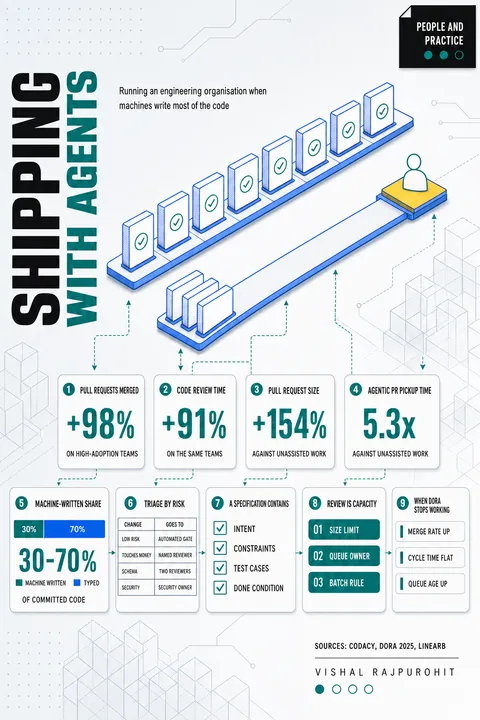
Shipping With Agents
Running an engineering organisation when machines write most of the code
When authorship stops being the constraint, specification and review become it, and an organisation that keeps its old review, ownership and measurement model just converts a coding bottleneck into a queue.
Merge rate goes up, cycle time does not move, and everyone blames the tooling. The tooling is fine; the operating model is not. This book redesigns the functions that authorship used to absorb: what a specification has to contain now, how to triage review by risk, what PR size and queue discipline actually buy, who owns code nobody typed, how tests become the contract with the agent, and which delivery metrics still mean anything once most committed code is machine-written.
What it makes operable
- 01
Redesign review as scarce capacity, with triage, size limits and a named owner per queue
- 02
Write specifications and tests that hold an agent to a contract
- 03
Measure delivery when most committed code was not typed by a person
- 04
Keep ownership and craft intact as adoption increases
Contents
14 of 14 published
Every chapter is free to read in the browser, cites its own sources, and stands on its own if you came for one decision rather than the whole argument.
- 01The Bottleneck MovedMore merged pull requests, the same cycle time, and where the hours went.12 min
- 02What a Specification Has to Contain NowWriting intent precisely enough that a machine can implement it.12 min
- 03The Standards Every Agent InheritsThe repository-level context that decides code quality before a reviewer sees it.12 min
- 04Tests as the Contract With the AgentThe suite as the specification an agent is actually held to.12 min
- 05Review as the Scarce ResourceTreating reviewer attention as capacity to be planned, not goodwill to be spent.12 min
- 06Automated First-Pass Gates and Risk-Based TriageMoving baseline correctness off people, and routing low-risk change around them.12 min
- 07PR Size, Batching, and Queue DisciplineLimits and batching rules that stop the queue from becoming the product.12 min
- 08Making a Revert Cheaper Than a Careful ReadRollback, flags and blast radius as the control that lets you triage review at all.12 min
- 09Ownership When Nobody Typed the CodeAccountability, on-call and code ownership for generated change.12 min
- 10Security and Compliance Inside the LoopPutting controls where the agent works instead of downstream of it.12 min
- 11Measuring Delivery When DORA Stops WorkingWhich metrics survive, which mislead, and what has to be added.13 min
- 12The Two Cost Lines Nobody CountsSeats and tokens are on the invoice; review hours and incident cost are not.12 min
- 13Juniors, Craft, and Not Deskilling the TeamBuilding judgement in people who never had to write the easy version.12 min
- 14Adopting This Without Breaking the TeamA sequence of changes engineers will not have to resist.12 min
Evidence · 3 sources
Third-party sources behind the book's premise. Every figure in them belongs to the party that published it and is attributed to them in the text.
In the age of AI
The advantage was never the model. It's knowing what to build with it — and having a team that can actually ship it.
That's the part I help with: finding where AI genuinely makes your business faster, deciding what's worth building, and standing behind it once it's live.
Four offices, one very full passport
Every dot on this map is a conversation I still remember.

- Where I've spoken
- Office